In China, between 1073 and 1040 BC, the Shang Dynasty falls to the virtue of the Zhou
FARTHER TO THE EAST, Wu Ting had passed his throne, after a sixty-year reign, to his son. The Shang kingship went on, for some years, from brother to brother or father to son, more or less in peace. The center of the Shang empire was the Yellow river, and the Shang capital remained at Yin.
By the time that the Mesopotamian kingdoms had begun to crumble, though, the kingship of China was also in crisis.
It was a very different crisis than any faced by Nebuchadnezzar I or Tiglath-Pileser. The Shang kings and their people were not dealing with the invasions of unknown foreign tribes; the Shang king’s enemies were the cousins of his own people.
Just west of the Shang lands, the Zhou tribe lay across the Wei river valley. They were not exactly subjects of the Shang king, although their chief—the “Lord of the West”—paid lip service to the authority of the crown. Their land, after all, lay almost four hundred miles distant from the capital. Oracle bones travelled back and forth between the Lord of the West and the Shang palace, keeping a path of shared language and customs open.1 But the Zhou noblemen were loyal first to their own lord, not to the distant Shang monarch. When rebellion broke out, they looked to the Lord of the West for their orders.
THE ANCIENT CHRONICLES make it very clear that the Shang kings brought this rebellion on themselves. They abandoned wisdom, and this wisdom (not military might, as in the west) was the foundation of their power.
The emperor Wu-yi, the fifth ruler to follow Wu Ting, showed the first signs of decay. His offenses, according to Sima Qian, were primarily against the gods: he made idols, “called them heavenly gods,” and played lots with them. When he won, he mocked the idols as lousy gamblers.
42.1 Shang and Zhou
This was a serious breach of his royal responsibilities. With more and more weight being placed on the oracle-bone ritual, the royal court had become the center of divine revelations from the ancestors to the living. All queries to the ancestors were carried out in the name of the king; he was the conduit for the messages from the divine powers. For him to mock those powers was appalling.
The punishment fit the crime; Wu-yi was struck by lightning while out hunting. He was succeeded by his son and then his grandson, under whom (according to Sima Qian) the country declined still more. Then his great-grandson Chou inherited, and the Shang authority crashed.
Chou was gifted with natural graces—Sima Qian praises him for his strength, intelligence, articulateness, and perception—but he used them all for ill. “His knowledge was sufficient to resist remonstrance,” Qian writes, “and his speech was adequate to cover up his wrongdoing…. He considered everyone beneath him. He was fond of wine, licentious in pleasure, and doted on women.” Chou’s love of wine and pleasure led him to raise taxes so that he could stock his hunting forests and pleasure parks with game; his love of women put him under the spell of a cruel and domineering courtesan named Ta Chi, whose words became the only ones he would hear. His love of spectacle grew so great that he built a pool and filled it with wine, hung meat like a forest around it, and “made naked men and women chase one another” around the pool and through the forest.2
Weird frivolity gave way to serious tyranny. Noblemen suspected of disloyalty were forced to lie on a red-hot rack. Chou had one court official flayed, and another carved up into meat strips and hung to dry. When his uncle remonstrated with him, he remarked that since the heart of a wise man had seven chambers, he would need to examine his uncle’s heart with his own eyes before heeding his advice—and then carried out the threat. His cruelty worsened until “it knew no end.” The noblemen—the “families of the hundred cognomens,” those with honorable names—were “filled with resentment and hatred.”
Finally he overstepped himself. The Zhou chief Wen, the Lord of the West, was in the capital on business, and Chou had set his spies to follow him. When the spies reported that the Lord of the West had “sighed in secret” over the behavior of the king, Chou had Wen arrested and thrown into jail.101
Hearing that their lord was in jail, the Zhou tribes brought Chou the kind of tribute likely to soften his heart: fine objects and beautiful women. Chou, properly touched, set Wen free. But the Lord of the West refused to return home without making some effort to shield Chou’s oppressed subjects from the king’s brutality. He told Chou that he had a proposition for him; if he would promise to stop using his red-hot rack, Wen would gift him with the fertile Zhou land around the Lo river, which flowed south to join the Wei. Chou, who had done very well out of Wen’s imprisonment, agreed to the deal, took ownership of the land, and sent Wen home.
This turned out to be a mistake. Wen was much loved in his own lands as a warrior-king who was both good (as shown by his willingness to sacrifice his own lands for the people) and mighty (the later Chinese historian and philosopher Mengzi mentions, offhand, that he was ten feet tall).3 Back in the west, he began quietly to round up opposition to the king. “Many of the feudal lords rebelled,” Qian writes, “and turned to the Lord of the West.” They were joined by the sages of the court who read the oracle bones and divine prophecies; they rose up en masse with all their instruments of ritual, left the court, and marched west.
Wen, by this time an elderly man (a hundred years old, according to Mengzi), died before he could lead his followers into the Shang capital.4 But his son Wu took up his banner. Eight hundred of the feudal lords lined up behind him, each with their own soldiers. The Zhou army of fifty thousand marched towards the Shang palace at Yin. And Chou ordered his own troops out to meet the attack: seven hundred thousand strong.
The two armies met about twenty miles outside Yin, at the Battle of Muye. By any measure, the imperial army should have crushed the tiny rebel force, but the Zhou had two advantages. The first was tactical: Zhou noblemen had provided three hundred war-chariots, while the royal army had none at all.5 But it was the second advantage—the Zhou possession of the moral high ground—that turned the battle against the king. The king’s men, disgusted with their leader’s cruelty, were ripe for defection. As the Zhou line thundered towards them, the Shang soldiers in the front line reversed the direction of their attack and drove the men behind them back, turning the entire army around and throwing it into flight.6
Seeing the inevitable defeat looming, Chou retreated to his palace, where he donned jade armor in preparation for a last stand. But the invading Zhou forces burned the palace down around his ears. He died in flames, a poetic end for the man who had used fire to torture and kill.
There is in this story a strong whiff of discomfort with Wen’s revolt. The ancient historians do not celebrate the overthrow of the tyrant, and Wu makes no boast of reigning from horizon to horizon, or of piling enemy heads by the gates. He is praised not for his skill at fighting, but for his restoration of proper order.
The rebellion of the Zhou is not exactly the disobedience of a governed people. Even before the revolt, the Shang king had an ambiguous power over the Zhou. Wen was a king in his own right, but the Shang king was able to throw him in jail and force a ransom. On the other hand, when Wen offered Chou a gift of land, the king recognized it happily as a present, rather than pointing out indignantly that he already ruled it.
But the ancient historians still find themselves forced to justify the Zhou defiance. The Zhou and Shang were sibling cultures, and battles between them were as disconcerting as the hostility between Set and Osiris in the early years of Egypt. It is positively necessary that the first Zhou king be, not a lawless subject, but rather a virtuous man who rises up to overthrow vice and begin the cycle again. For this reason, the Zhou rule is dated not from the victorious Wu, but from his father, who was unjustly imprisoned and who willingly sacrificed land for the good of his people. He, not his warlike son, is considered to be the first Zhou king. The Shang rule is said to have ended not at the gates of the burning palace, but back when the noblemen and the oracle-readers gathered under the leadership of the Lord of the West. And the Zhou takeover was not the invasion of an enemy people. Chou’s own lawlessness was the cause of his death. For the Chinese chroniclers, rot always came from within.
Virtue notwithstanding, Wu of the Zhou claimed his new title by thrusting a pike into Chou’s singed head and staking it out in front of Yin’s gates for all to see. The old order had perished in fire; the new order had arrived.
During his inspection of the battlefield, Benteen decided that there was no pattern to how the more than two hundred bodies of Custer’s battalion were positioned. “I arrived at the conclusion then that I have now,” he testified two and a half years later, “that it was a rout, a panic, till the last man was killed. There was no line on the battlefield; you can take a handful of corn and scatter it over the floor and make just such lines.” Today many of the descendants of the warriors who fought in the battle believe the rout started at the river.
According to these Native accounts, Custer’s portion of the battle began with a charge down Medicine Tail Coulee to the Little Bighorn. The troopers had started to cross the river when the warriors concealed on the west bank opened fire. The grandmother of Sylvester Knows Gun, a northern Cheyenne, was there. The troopers were led, she told her grandson, by an officer in a buckskin coat, and he was “the first one to get hit.” As the officer slumped in his saddle, three soldiers quickly converged around the horse of their wounded leader. “They got one on each side of him,” she said, “and the other one got in front of him, and grabbed the horse’s reins . . . , and they quickly turned around and went back across the river.” Sylvester Knows Gun maintained that this was Custer and that he was dead by the time he reached Last Stand Hill.
The wounding, if not death, of Custer at the early stages of the battle would explain much. Suddenly leaderless, the battalion dissolved in panic. According to Sylvester Knows Gun, the battle was over in just twenty minutes.
There is evidence, however, that Custer was very much alive by the time he reached Last Stand Hill. Unlike almost all the other weapons fired that day, Custer’s Remington sporting rifle used brass instead of copper cartridge casings, and a pile of these distinctive casings was found near his body. There is also evidence that Custer’s battalion, instead of being on the defensive almost from the start, remained on the offensive for almost two hours before it succumbed to the rapid disintegration described by Sylvester Knows Gun and others.
It may very well be that the warriors’ descendants have it right. But given the evidence found on and in the ground, along with the recorded testimony of many of the battle participants, it seems likely that Custer lived long enough to try to repeat his success at the Washita by capturing the village’s women and children. What follows is a necessarily speculative account of how this desperate attempt to secure hostages ultimately led to Custer’s Last Stand.
Runs the Enemy had just helped drive Reno’s battalion across the river on the afternoon of June 25. He was returning to the village when he saw two Indians up on the ridge to the right, each one waving a blanket. They were shouting, he remembered, that “the genuine stuff was coming.”
He immediately crossed the river and rode to the top of the hill. He couldn’t believe what he saw: troopers, many more troopers than he and the others had just chased to the bluffs behind them. “They seemed to fill the whole hill,” he said. “It looked as if there were thousands of them, and I thought we would surely be beaten.” In the valley to the north, in precisely the same direction the troopers were riding, were thousands of noncombatants, some of them moving down the river toward a hollow beside a small creek, others gathered at the edge of the hills to the west, but all within easy reach of a swiftly moving regiment of cavalry. While Runs the Enemy and the others had been battling the first group of soldiers, this other, larger group of washichus had found a way around them and were now about to capture their women and children.
He rushed down to the encampment where the Lakota warriors returning from the battle with Reno’s battalion had started to gather. “I looked into their eyes,” he remembered, “and they looked different—they were filled with fear.” At that moment Sitting Bull appeared. Riding a buckskin horse back and forth, he addressed the warriors along the river’s edge. “A bird, when it is on its nest, spreads its wings to cover the nest and eggs and protect them,” Sitting Bull said. “It cannot use its wings for defense, but it can cackle and try to drive away the enemy. We are here to protect our wives and children, and we must not let the soldiers get them. Make a brave fight!”
As the warriors splashed across the river and climbed into the hills, Sitting Bull and his nephew One Bull headed down the valley. They must prepare the women and children to move quickly. As Sitting Bull admitted to a newspaper reporter a year and a half later, “[W]e thought we were whipped.”
In the vicinity of a hill topped by a circular hollow that was later named for his brother-in-law Lieutenant James Calhoun, Custer convened his final conference with the officers of his battalion. The Left Wing had just returned from its trip to the river. The Right Wing had marched up from a ridge to the south where it had been waiting for the imminent arrival of Frederick Benteen. The white-haired captain and his battalion were still nowhere in sight, but Custer could take solace in knowing that even though Benteen had dawdled at the Washita, he had come through splendidly in the end.
Ever since the Crow’s Nest, Custer had been pushing as hard as he possibly could. His scouts had told him it was a big village, but they had also told him the Indians were on the run. So he had divided his command rather than let the Indians slip away. To send Benteen off to the left was one thing; to veer suddenly to the right and climb to the bluffs while Reno charged a village of unconfirmed size was quite another. That had been a mistake, he could now see, but there was still a way to win this battle. If he could cross the river to the north and secure hostages, he’d have the key to victory. But to accomplish this, he needed more men.
Given the large size of the village, the prudent thing to do was to backtrack to Reno and Benteen and reunite the regiment. But to do that was to give up any hope of securing hostages. The only option, to Custer’s mind, was to prepare for a decisive thrust to the north. As Captain Myles Keogh and the Right Wing continued to wait for Benteen, he and Yates’s Left Wing would scout out a ford. The plan required Custer to divide his already divided command once again, but only temporarily. Even before he’d found the crossing, Keogh and Benteen should be on their way to join him for the attack.
The risks, of course, were considerable. But Custer’s all-or-nothing approach was not new. At the Washita, he might have attacked the huge village to the east if the scout Ben Clark had not talked him out of it. As recently as the Yellowstone campaign of 1873, Custer had launched into a much larger force of well-armed Lakota warriors and might have been wiped out if not for the arrival of General Stanley’s artillery. Soon after that engagement, Captain Yates had been sitting on a log with two other officers. “Gentlemen,” one of them said, “it is only a question of time until Custer will get us into a hole from which we will not escape.”
The Crow interpreter and scout Mitch Boyer had never served with Custer prior to this campaign. He had undoubtedly heard of the general’s reputation for aggressiveness, but this last-minute push for hostages seems to have struck him as doomed from the start. The other battalions, Boyer told Curley, had been “scared out” and were not about to respond to Custer’s summons. “That man,” Boyer said, “will stop at nothing. He is going to take us right into the village, where there are many more warriors than we are. We have no chance at all.”
Eight years before, at the Battle of the Washita, a scout had somehow managed to persuade Custer to relent. Not this time. Boyer advised Curley to escape to the east before it was too late. For his part, Boyer elected to remain with Custer to the end.
Hindsight makes Custer look like an egomaniacal fool. But as Sitting Bull, Runs the Enemy, and many other Lakota and Cheyenne realized that day, he came frighteningly close to winning the most spectacular victory of his career.
From a distance the surrounding hills of grass and sagebrush seemed to be smooth and rolling; in actuality, they were crisscrossed with hidden coulees, gulches, and ravines. As Custer and the Left Wing marched north and Keogh’s Right Wing awaited Benteen in the vicinity of Calhoun Hill to the south, hundreds of warriors streamed up from the Little Bighorn through this vast, virtually invisible network of dry watercourses.
From earliest childhood, a warrior was taught how to stalk game without being detected, and this was exactly what was happening now. The Cheyenne and Lakota could see the soldiers, Wooden Leg remembered, but “the soldiers could not see our warriors, as they had left their ponies and were crawling in the gullies through the sagebrush.” The Cheyenne Kate Bighead had been at the Washita when Custer had attacked eight years before. After hiding in the brush during Reno’s attack, she was now on a pony, well back from the soldiers on the hill, and not even she could see the warriors creeping toward Keogh’s battalion. The only evidence she could detect of the hundreds, perhaps thousands, of Indians infiltrating the hills was the many ponies left tied to the sagebrush.
Every now and then one of the warriors leapt up, fired his rifle, and disappeared once again into the grass as he continued to work his way toward the soldiers. Arrows were even more effective in harassing the troopers and especially their horses. The arrow could be launched in a high, arching curve without betraying the location of the warrior with a telltale cloud of black powder smoke. “The arrows falling upon the horses stuck in their backs,” Wooden Leg remembered, “and caused them to go plunging here and there, knocking down the soldiers.”
Some of the warriors grew impatient with the slow creep toward the enemy. Remaining mounted, they rode back and forth in front of the soldiers, inviting them to fire. One of these was Sitting Bull’s nephew White Bull. Leaning over the side of his bareback pony while he clung to the mane with both hands, White Bull set out on a daring bravery run that elicited a crackling shower of carbine fire. There were others, Wooden Leg remembered, who challenged the soldiers to shoot at them. Several times Keogh’s soldiers attempted to check the rising tide of warriors with a volley or two, but for the most part the firing on both sides remained haphazard and ineffective. According to Kate Bighead, this period of “fighting slowly, with not much harm to either side” lasted for close to an hour and a half.
—THE LAST STAND, June 25, 1876—
As anyone who has ridden a horse across the Little Bighorn Battlefield knows, once you are down within the smothering embrace of this grassy landscape, you have no way of knowing what is happening around you. It is quite likely that as the troopers of the Left Wing worked their way north, they found themselves in a surprisingly quiet, self-contained world, almost completely insulated from the growing sense of alarm gripping the officers and men of the Right Wing to the south.
About a mile to the north, Custer, Yates, and the Left Wing found a buffalo trail that led down from the ridge to the river. As they approached the Little Bighorn, a group of young Cheyenne warriors fired on them from the hills behind. Ahead of them, on the south side of a wide loop in the river, was what they were looking for: a ford that provided access to the noncombatants gathered a short distance to the west.
Concealed in the brush beside the river was a group of Cheyenne warriors. As had occurred earlier at Medicine Tail Coulee, the warriors opened fire as soon as the Left Wing approached the river. “[The warriors] hit one horse down there,” Hanging Wolf remembered, “and it bucked off a soldier, but the rest took him along when they retreated north.” As had also been true during Custer’s earlier venture to the river, this was a reconnaissance mission, and the troopers quickly turned back.
Whether it was fired by the Indians stationed at the ford or by those in the hills to the east, one of the warriors’ bullets struck and killed the newspaper reporter Mark Kellogg. Three days later, the reporter’s body, all by itself along the remote reaches of the river, was one of the last to be discovered.
Thutmose III, everybody agrees, was the greatest warrior Egypt ever produced. He has been compared with Alexander and Napoleon, particularly the latter; for when Thutmose’s mummy was found and examined, the anatomist Grafton Elliot Smith reported that he was a little fellow, slightly over five feet tall—pretty short, even for an ancient Egyptian. This led to the usual psychological cliches about little men and their need to prove their manhood. It wasn’t until fairly recently that someone actually took another look at the mummy and pointed out that the feet were missing. Remeasurements and recalculations resulted in quite a different figure. Thutmose was of average height for an Egyptian—approximately five feet seven inches.
This is a relatively minor point, I suppose, but I mention it because it is further proof of the advantages of revisionism. To claim that Thutmose’s accomplishments were “compensation” for a subconscious sense of inadequacy or frustration is a cheap explanation. He was, as his adult life demonstrates, a man of varied and profound capabilities. Soldier, strategist, statesman, administrator—in each of these roles Thutmose displayed both energy and imagination. To accomplish all he accomplished in one lifetime, he must have been one of those irritating people who sleep only four hours a night and spend their waking hours operating at the highest pitch of efficiency.
It is a pity that physiognomy is not a reliable reflection of character, for while we cannot explain what went on behind Thutmose’s face, we know pretty accurately what he looked like. His is not a handsome face, for its regularity is marred by one outstanding feature. Thutmose III excelled his predecessors in nose as in everything else and bore it as proudly as Cyrano bore his.
We happen to have unusually detailed records that relate the military exploits of the Conqueror. The basic source is a long inscription called the Annals of Thutmose III. It was recorded on the walls of the temple of Karnak, and there it may be read today by any visitor who can decipher hieroglyphs. The stone-carved inscription was copied from an original, probably written on leather, by a man named Thaneni. In his tomb, Thaneni says proudly that he followed Thutmose III on his campaigns and “recorded the victories which he won in every land, putting them into writing according to the facts.” He was evidently the official army historian or military scribe, and it is to him that we owe the famous tale of the Battle of Megiddo with which the Annals of Karnak begin. But the man who supervised the carving of the copy was a priest, whose chief interest was not in battles but in booty, much of which went to the temple. As the Annals continue, they gradually degenerate into a prosaic list of tributes with only tantalizing hints of battles and brilliant strategies. Fortunately, we have other sources. The most useful is the tomb auto biography of a soldier named Amenemhab, who was second only to the royal warrior himself in valor. Other inscriptions that tell of the exploits of Thutmose the Great have been found at Gebel Barkal in Nubia and at Armant.
In the eighth month of his twenty-second year Thutmose left Tharu, the last Egyptian city on the northeast frontier, at the head of his army. His purpose, “to extend the boundaries of Egypt”—a candid avowal of motive, which is not found in the annals of most conquerors. In fact, the expedition marched to counter the threat mentioned in the preceding chapter, a threat posed by the great confederation of north Syrian states and their princes.
Ten days later Thutmose was at Gaza, a distance of 160 miles, not a bad pace for infantry. The date was significant: exactly twenty-two years earlier, Thutmose had been crowned king of Egypt. He arrived at Gaza on the fourth day of the Egyptian month Pakhons, and he left the city on the fifth day. On the sixteenth day he encamped at Yehem, a town on the southern slopes of the Carmel Mountains.
Thutmose’s goal was the city of Megiddo, in the plain on the northern side of the mountains. Megiddo had been fortified by the allies, who were under the command of the powerful king of Kadesh, because of its important strategic position as well as its reputation as an invincible fortress; it commanded the best road from Egypt to the Euphrates and was a populous city before and after Thutmose III.
Thutmose called his officers together for a council of war. The problem: how to cross the mountain ridge and reach the plain. There were three possible roads. One came out of the mountains north of Megiddo and one skirted the slopes of the city. The third route was the shortest and most direct. But the direct route had one conspicuous disadvantage, which the officers promptly pointed out.
“How can we go upon this narrow road, when it is reported that the enemy is waiting? Must not horse go behind horse, and soldiers and people likewise? Shall our vanguard be fighting while the rear stands in Aruna, unable to fight?”
This makes very good sense militarily. However, as we saw in the story of Kamose, the caution of the royal council is a favorite Egyptian literary device and is intended to contrast with the valor and reckless courage of the king.
“My Majesty will proceed along this road of Aruna,” the king swore, with great oaths. “Let him who will among you go upon those roads of which you speak, and let him who will among you come in the following of My Majesty.”
Naturally everybody followed His Majesty. Evidently courage was a royal attribute more cherished by the Egyptians than good sense. Thutmose only succeeded in this recklessness because his opponents were equally careless—which, to do him justice, he might have counted upon. He himself led the way through the narrow, treacherous pass, up the mountain ridge to the town of Aruna, where he spent the night. Next morning he pushed forward again and, before long, ran into the enemy. As the council had predicted, the rear of the Egyptian army was still in Aruna; but luckily for the Egyptians, the king, in the van, had reached a widening in the pass. Here the exasperated officers once more pleaded for caution.
“Let our victorious lord listen to us this time, and let our lord await the rear of his army and his people!”
This time Thutmose harkened. He waited till the rest of the army caught up with him. The enemy was not in sufficient force to oppose him, so he was then able to press forward and make camp south of Megiddo, on the bank of the brook called Kina.
Heaven knows what the king of Kadesh and his confederates were doing all this time. They might have won the battle if they had had scouts farther along the Aruna road, or had brought up reinforcements in time to deal with Thutmose when he first came out of the pass. Perhaps they assumed that no soldier of any intelligence would venture upon the Aruna road, so narrow and so susceptible to ambush. Or perhaps they counted on the strong walls of Megiddo, for when Thutmose led the chariot charge against them next morning, they broke with scarcely afight. “They fled headlong to Megiddo in terror, abandoning their horses and their chariots of gold and silver, and the people hauled them up into the city, pulling them by their clothing.”
The Egyptians enjoyed low comic touches of this sort, when the joke was on the enemy; the picture of the mighty prince of Kadesh being pulled up over the walls of Megiddo by his shirttails is rather funny. But what happened after that was not so amusing, and Thaneni, the army scribe, is bitter about it.
“Now if only the army of His Majesty had not given their hearts to plundering the belongings of the enemy, they would have captured Megiddo at this moment!” The sight of the abandoned horses (still uncommon and very valuable) and the jeweled equipment of the allies was too much for the Egyptian soldiers. They loyally carried the loot to the king, but Thutmose was not consoled. He urged the army on to victory: “The capture of Megiddo is the capture of a thousand towns!”
So the troops of Egypt had to pay for their greed with a long siege. They cut down the trees near the city and walled it in. The incompetent rebels had not planned to be besieged. They had left the very grain in the fields, and their empty stomachs must have felt even emptier as they looked over the city walls and saw the Egyptians munching the bread made from their crops. Famine finally took its toll; the “wretched Asiatics” came forth suing for peace.
Somehow or other the pièce de résistance of the confederation, the king of Kadesh, had slipped over both sets of walls one dark night and made his getaway; it is hard to imagine how, but he did. Despite this setback, Thutmose showed amazing clemency toward the inhabitants. Naturally, he took most of their property, but he allowed the allied soldiers transport to their distant homes. “Then My Majesty gave them leave to go to their towns. They all went by donkey, so that I might take their horses.”
In his haste to escape, the king of Kadesh had been forced to leave his family behind; either that “fallen one” was not bound by strong ties of familial affection or he relied rather trustingly on Thutmose’s clemency. His hopes were justified. Thutmose took them as hostages but did them no harm. It was safer to be besieged and captured by Thutmose III than by most later European conquerors.
After cleaning out the city of Megiddo, Thutmose took the road again, north to Lebanon. He subdued another confederation of three cities here and built a fortress. The season was growing late; the rains were due. Thutmose turned south toward Egypt, but not without a political stroke no less effective than his military exploits. He had appointed new chiefs for the conquered countries, to supplant the “rebellious” princes. The sons of the new rulers were taken to Egypt by the canny king, whose scribe explains: “Now whosoever of these princes died, His Majesty would cause his son to stand in his place.” The heirs of the Asiatics served as hostages for the loyalty of their fathers; and when they in turn came to rule their vassal cities they had become Egyptian in custom and language and sympathy, identifying themselves with the cultured Egyptians among whom they had been raised from childhood rather than with their own humble subjects. It was a masterstroke, and this is the first recorded instance of its being practiced, though later conquerors found it equally useful.
The city of Thebes was in celebration when the king returned, and Amon had the best cause to rejoice; he got the lion’s share of the plunder. Not only gold and jewels, but also land in conquered Lebanon and in Egypt itself went to the god, with cattle to graze thereon and slaves to tend it.
The following year Thutmose was off again—an easy swing through the conquered territories to check up on the princes he had left in power. The chieftains’ collective memory was good; they poured in with tribute and assurances of undying devotion. There were also gifts from the king of Assyria, then a young nation on the threshold of its later power. The Egyptians blandly recorded these gifts, as they would do with other gifts from more powerful monarchs, as “tribute.” If a wandering Assyrian reached Egypt and was able to read the Karnak inscriptions—an unlikely event—he would hardly be in a position to contradict them. It’s possible that the gifts were reciprocated.
The energetic king had now worked out a schedule to which he would adhere for the rest of his life: half the year in the field, the other half in Thebes, organizing, building, and checking on what had been done in his absence. The army marched from Egypt after the spring harvests, which occurred earlier in that country than elsewhere in the Near East, and arrived in Syria just in time to swoop down on the enemy’s ripening grain. When the rainy season approached, Thutmose turned homeward, reaching Thebes some time in October.
Thutmose devoted his third and fourth campaigns to further consolidation of territory already won. The records of the third campaign at Karnak are rather striking, although they do not note any great battles; instead, the walls depict long rows of plants and animals that were brought back, at the king’s command, from Syria. This suggests a certain degree of intellectual curiosity on the part of Thutmose; we wonder what other subjects engaged his interest. But few records touch upon this attractive trait; conquest was a more dramatic subject for reliefs than was scholarship.
In Thutmose’s early campaigns we may see a leitmotif that emerges more clearly as the years pass. The great adversary at Megiddo, the leader of the allies, was the king of Kadesh. The Egyptians never gave him a name, for reasons which we have explained before, but he was a shrewd and cunning adversary and a constant thorn in Thutmose’s side. We recall that the successful siege of Megiddo did not net this wily bird; he had escaped, leaving his family in Thutmose’s hands. In the next five years Thutmose must have realized that he would eventually have to face and crush Kadesh and its king, but he was no longer the impetuous youth who had led his army through the dangerous pass of Aruna. His fifth campaign dealt with the Phoenician cities of the coast, hitherto unmolested. This move had its place in a larger strategy; Thutmose could not advance northward toward Kadesh with the potential threat of Phoenicia behind him. Cunningly, he avoided the southern coast and struck by sea at the wealthy northern kingdoms of Phoenicia. Two great battles, and the coast was won; the other chieftains sent messages of submission.
Thutmose returned home by sea, the first part of his long-range plans completed. The next campaign was to be against Kadesh itself.
Kadesh was a hard nut to crack, even for Thutmose III. It was entirely surrounded by water, with rivers on two sides and a canal on the third; moats and formidable walls made it perhaps the strongest fortress in all of Syria. Thutmose laid siege to the city. Thanks to the materialistic orientation of the scribe who recorded this campaign, we can’t even be sure whether he conquered it or not. Amenemhab, Thutmose’s trusted officer, was there; but since his memoirs were designed to be carved in his tomb, they naturally concern themselves primarily with the bravery of Amenemhab. We can only conclude that he was not especially brave upon this occasion.
What happened to the adversary, that “fallen one,” of Kadesh? The records are infuriatingly silent on this point. Evidently the king of Kadesh repeated his earlier exploit and got away from the beleaguered city. He was certainly a leading advocate of the “he who fights and runs away” school of thought. We have not heard the last of him yet.
Thutmose regarded Kadesh and not its king as the major goal of this campaign, for he went on to the next stage of what had become a truly ambitious plan. Whether he had dreamed of his final goal from boyhood, or whether he dared envision it as his triumphant army proceeded, almost unopposed, through the highlands, we do not know. It was a dream worthy of a conqueror, and it had precedent. Years before, his grandfather Thutmose I, to whom he owed not only filial respect but the admiration of one fine soldier for another, had led his armies to the banks of the Euphrates—that strange inverted water whose current actually flowed from north to south instead of in the normal, decent manner. The inverted water had now begun to haunt the slumbers of Thutmose III. But between him and the Euphrates lay a sizeable obstacle—not a loosely bound confederation of small city states, but the mighty empire of Mitanni, or Naharin.
The kingdom of Mitanni is still one of the unsolved mysteries of Near Eastern archaeology. To be sure, we know it was there, which could not have been said a century ago. But its capital, known as Wassukanni, has never been found, and its language is still imperfectly understood. Most of what we know of this flourishing country, one of the half-dozen great powers of the second millennium B.C., we know from records of other nations. During the fifteenth century before Christ, a group of alien warriors, trainers, and breeders of horses came down from some unknown homeland in farther Asia and subjugated the indigenous peoples of the area near the Upper Euphrates. They spoke an Indo-European language, these cavalrymen, and the gods they worshiped have been connected with the deities of India—Mitra, Indra, Varuna. At its peak the empire of Naharin extended from the Zagros to the Mediterranean, and from Lake Van to Asshur. Its interests naturally extended to the part of northern Syria that lay near its own borders.
These were the people whom Thutmose III meant to face next. The attack on Mitanni was not out-and-out aggression; the king of that nation had backed the confederation of the chieftains of Syria, which was crushed in the battle of Megiddo. However, it is not likely that Thutmose was worrying about justification.
Before undertaking his greatest battle, Thutmose took every precaution for success. He spent a year making sure that his territories in Syria were under control, and a further year in Egypt making ready. The following year he was on his way.
One little touch displayed during this famous campaign shows Thutmose’s foresight, as well as his self-confidence. In Byblos, on the Phoenician coast, he had ships built of the famous cedar. Loaded on carts drawn by oxen, “they journeyed in front of My Majesty, in order to cross that great river which lies between this foreign country and Naharin.” The river is, of course, the Euphrates, and the poor oxen must have had a time of it, all the way from Phoenicia.
Senzar, Aleppo, Carchemish—one after another the cities of north Syria fell or sent messages of submission. Thutmose’s reputation had evidently preceded him. The king of Naharin fled before him, abandoning his country to fire and the sword. Thutmose crossed the river on his cedar boats and laid waste to Naharin, carry ing its people away captive to Egypt. Upon reaching the river, he erected a stela beside that of his grandfather Thutmose I.
Thutmose must have been in his glory as he turned back toward Egypt, conquering a town here and there as he marched. By an ironic touch of fate, he came closest to disaster at the time of his highest triumph; his life was saved only by the prompt action of his devoted follower Amenemhab. This was one of the great moments of the general’s life, and he remembered it vividly even when, as an old man, he sat recounting his deeds to the patient scribe who would supervise their recording for eternity. One of the cities Thutmose scooped in on his way home was called Niy. After the battle of Niy, word got around that there was a herd of elephants in the vicinity, and the king decided to take time out for relaxation. There were 120 beasts in the herd, which the Egyptians hunted, and one of them—“the largest,” according to modest Amenemhab—charged the king. Standing in the water between two rocks, the general placed his body between his king and danger, and cut off the beast’s “hand.” He was rewarded with gold—and changes of clothing. One would hope so, indeed. An elephant in a river can raise considerable surf, and if Amenemhab really did sever its trunk there must have been other stains than those of water on his linen kilt.
We know only this single narrow escape of the king’s, thanks to the “shrivelled soul of the ancient bureaucrat” who recorded the campaigns at Karnak. The epithets are those of Breasted, who goes on to add, bitterly, that the ancient scribe “little dreamed how hungrily future ages would ponder his meagre excerpts.” Of course, Thutmose must have had his share of wounds and danger; he never led his regiment from behind. But the myth of the invincible king, armored in his divinity, is never questioned in the official records.
One might suppose that Thutmose could now safely rest upon his laurels. For ten years he had spent half of his time in the field; he had extended the empire farther than had any king who ever ruled Egypt; and the plunder that poured into the capital at Thebes must have dazzled the eyes of the watching populace. He had enlarged the temples and built new ones, sent caravans to Punt and the Sudan, and received gifts from Babylon and Hatti.
But the conquered lands were too new to subjugation to bear it lightly, and Thutmose had to maintain his empire or give it up. He had another twenty years of life before him, and in that time he fought nine more campaigns. One need not suppose that the task was unpleasant; by inclination and by habit Thutmose may have preferred the life of the camp to that of the courtly halls of Thebes, with their rich decorations of gold and faience—and their tedious round of ceremonial duties. He had his staff, well trained and devoted: Thaneni, the scribe who recorded the exploits of His Majesty; Amenemhab, the trusted general who had saved him from the elephant in Niy; Intef the marshal, a prince of Thinis, who had the king’s apartments in tent or conquered palace ready for him when he arrived at night; Thutiy, the prince and priest and commander of the army, who conquered Joppa by a trick straight out of the Arabian Nights, if we can believe a folktale of a later date. Thutiy’s soldiers entered the city hidden in panniers borne by a train of donkeys—the precursor not only of the Trojan Horse but of Ali Baba. This tale is fiction, but Thutiy is not. His tomb has been found, as well as a beautiful golden dish, bearing his name and titles, which was given to him by Thutmose as a reward for one of his valorous deeds—could it have been the conquest of Joppa?
With such men behind him, Thutmose could venture greatly. And he could do so with his mind at ease about the welfare of the Two Lands, for he had left another trusted servant as vizier, a man named Rekhmire.
Rekhmire’s tomb is one of the showplaces of Thebes today. It lies on the hill of the Sheikh Abd el Gurnah, on the west bank of the Nile, where many of the great nobles of the Empire are buried. The walls of the tomb show us, in brilliant detail, how rich and how sophisticated was the life of a nobleman of that imperial age. The tomb also gives an interesting account of the duties of the vizier. And what duties they were! The vizier was in charge of everything. He was a whole cabinet in himself—secretary of state, receiving embassies and reviewing tribute in the king’s absence; secretary of the treasury, since the chief treasurer reported to him, and he was responsible for taxation; secretary of the interior and of agriculture, supervising the water supply, the plowing, and the canals; attorney general and chief justice; secretary of war, with both army and navy under his control; secretary of labor, for he regularly inspected the royal craftsmen, from cabinetmakers to sculptors. In his spare time the vizier wore several other hats: he was mayor and chief of police of the residence city and was also in charge of the royal messengers and the king’s personal bodyguard. Rekhmire’s tomb inscriptions mention all these functions and others; then, just in case something has been overlooked, the writing adds: “Let every office, from first to last, proceed to the hall of the vizier to take counsel with him.”
The painted walls of the tomb depict Rekhmire in the process of carry ing out many of his onerous duties, which evidently did not take every moment of his time, for there is a spirited scene of a party at the vizier’s home, with wine flowing freely and the guests enjoying its effect. Since his accession to the vizierate was the high point of Rekhmire’s life, it is natural that his formal investiture in office should be the subject of another scene.
Here we see Thutmose III enthroned. Before him stands the new vizier, attentive to the exhortation that the king delivers. It is a sobering speech, which must have had the same import as a solemn oath of office. “Look to the office of the vizier,” Thutmose begins, “and be vigilant over everything that is done in it. Lo, it is the mooring post of the entire land; lo, it is not pleasant at all—no, it is bitter as gall.” Foremost among the responsibilities of the vizier is justice. “The abomination of the god is partiality. So this is the instruction: look upon him whom you know like him whom you do not know, upon him who has access to your person like him who is distant from your house.”
If Rekhmire took his responsibilities seriously, his position as judge must have been the most sobering of all his duties. He was by proxy the dispenser of that justice which is higher than human. The tomb walls show him to us in this awesome task, seated in the hall of justice; before him are forty leather whips, which were the symbols of the discipline he could wield if he chose. For a long time these forty pictured objects were believed to be leather rolls containing a law code that governed the vizier’s decisions; and how Egyptological mouths watered at the prospect of one day finding such rolls! Peculiarly enough, the Egyptians had no such written code of laws. The other peoples of the Near East did; the Code of Hammurabi is the most famous, but there are earlier examples from the same area. Perhaps it was not strange that to the best of our knowledge the Egyptians never developed formal codified law, since the judgment of the god-king and his proxies was, by definition, straight from heaven.
Rekhmire implies that Thutmose kept a close check on the activities of his subordinates; if so, he was satisfied with what he found, for he left Egypt to their administrations half of each year while he carried out his military objectives. Most of the king’s remaining nine campaigns were tours of inspection, gentle reminders to the dynasts in Syria that though they might be far from Egypt geo graphically, they were only days removed from the all-seeing eye and all-powerful arm of the king.
The tenth campaign had to deal with a more serious problem—a resurgence of the king of Naharin and his allies. The battles Thutmose fought on this occasion daunted the proud princes of northern Syria for a good many years. Even on the relatively peaceful inspection tours, Thutmose maintained high standards of efficiency. Harbors were kept permanently supplied and garrisons were trained. “Tribute” continued to pour in, filling the treasuries of king and gods.
Thutmose had outlived Hatshepsut, subdued Mitanni, and conquered an empire; but there was one shadow out of his past which had never been exorcized. Once again, and for the final time, the prince of Kadesh reappears, out of the mists which had shrouded his activities forso long, to stand against the fighting hawk of Egypt. We have not heard of him since the battle of Kadesh, ten years before, when he mysteriously vanished from the beleaguered city. Where he had been, and what he had been up to, we do not know; but now he was ready for his last gamble with fate. He had engaged formidable support—Naharin again, and many of the coastal cities. His chief ally was the city-state of Tunip, to the north of Kadesh. Thutmose had fought in Syria for nineteen years, but if he lost this battle he might lose all that he had won.
The aging king (he must have been in his forties, which was old for that time) was prompt to take up the gage of battle. In the spring of the forty-second year of his reign, Thutmose’s fleet could be seen heading for a harbor on the north coast of Syria. Instead of marching up the river to Kadesh, he had decided to cut her off from her northern ally first. Tunip held him for a time, but he took it eventually, and then led his troops up the Orontes to Kadesh. And here Amenemhab, the old soldier who had cut off the elephant’s trunk, performed his second great deed.
The battle was fiercely fought by both sides. The stakes were tremendous, and the prince of Kadesh knew it. In his last, desperate attempt to turn the tide in his favor, he thought up a trick that was worthy of him: he sent a mare out of the city and had her driven toward the Egyptian army. The chariotry wavered as the stallions yielded to this exciting distraction. The prize of victory hung in the balance; and Amenemhab moved to weigh the scales. Leaping from his chariot, he ran the mare down and killed her. In a gesture of pure panache, he cut off the animal’s tail and presented it to the king. The assault on the city must have followed immediately; in an epic it could not be otherwise, and an epic king would have cried his army on with a great shout of laughter and a flourish of the mare’s tail. Amenemhab, carried away by his success, was first over the walls. Behind him poured the hard-bitten veterans of the Syrian wars. Against such men and such a leader even Kadesh the invincible had no chance. The city fell; and with it fell the last hopes of the Syrian cities for independence.
And what of the prince of Kadesh, who did not know when he was defeated? Once again we may invoke Breasted’s curse on the withered bureaucrat who recorded this campaign only as a list of booty collected. But we can deduce the fate of Thutmose’s archenemy from the silence that followed. Never again, in the ten years that remained to the king, did Syria rebel against her overlord. We cannot imagine such a state of peace and lethargy with the restless spirit of the prince of Kadesh still abroad in the land. The second battle of Kadesh was not a long-drawn-out siege, as the first had been. Thutmose was behind schedule that year, held back by the resistance of Tunip, and he had not time for such niceties. Kadesh was taken by storm, and its prince may not have had the opportunity to repeat his past escapes. Did he die in battle, in the last hopeless fight to save his city when the bronzed troops of Egypt swarmed over the wall; or was he captured by Thutmose and executed, as the greatest rebel of them all? Thutmose’s records do not mention the execution of enemies—who were, in the egocentric Egyptian view, guilty of rebellion and treason. It is, of course, unsafe to conclude from this silence that such executions never took place. Still, we may prefer to think of the prince of Kadesh as perishing in battle. We have a certain sympathy for him. Three times he had fought against the most invincible warrior of his age, the man to whom many of his peers had tamely surrendered without so much as a spear being cast. Megiddo, Kadesh, and Kadesh again…It would be interesting to find, some fine day, the buried records of the lost capital of Naharin, and see what they have to say about their ally of Kadesh. To his own men he was probably a patriot and a hero; to the Egyptians, just another rebel.
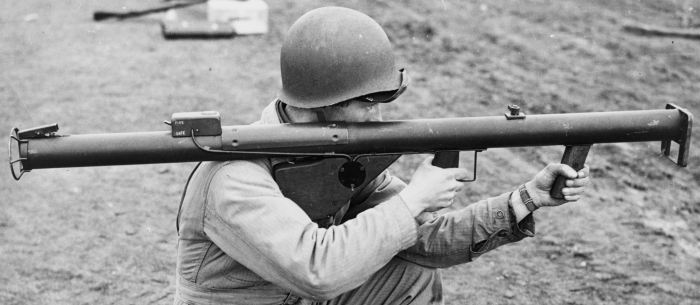
The M1 anti-tank rocket launcher came into existence in 1942 as an extended range delivery system for new shaped charge anti-tank grenade, developed by US Army. The new hand grenade was effective against current German tanks but was heavy, and its throwing range was dangerously short. Therefore, US Army Lt. Uhl added a small rocket motor to the rear end of the shaped charge AT warhead, and designed a simple tubular launcher to project it with reasonable degree of accuracy. The new AT rocked was officially designated as “Rocket, A.T., M6, 2,36 inch”, and the launcher was designated as “2.36-inch Anti-Tank Rocket launcher M1”. Both were adopted in mid-1942, and by late 1942, a simplified M1A1 launcher was adopted and put into production. The hastily developed M1 rocket launcher and M6 rocket had several serious reliability and safety issues, and by late 1943 US army adopted an improved M6A3 AT rocket and a new M9 rocket launcher. The popular nickname “Bazooka” came from similarity of the launcher tube to the tubular musical instrument of the same name invented and popularized in the 1930s by US comedian Bob Burns.
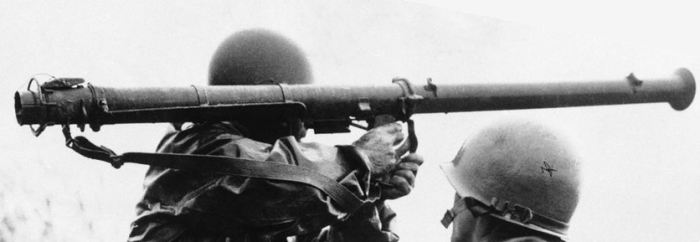
First operational use of the M1 anti tank rocket launcher by US troops was recorded late in 1942, in Northern Africa. Later M1 and M9 “Bazooka” AT rocket launchers were widely used in both European and Pacific theaters of operation, against enemy armor, field entrenchments and light fortifications, bunkers etc. By the end of the WW2 60mm rockets were considered to be insufficiently effective against most modern medium and heavy tanks, but US troops viewed them as useful light support weapons. M9 bazooka rocket launchers last saw extensive use by US forces during Korean war, but were found to be ineffective against Soviet-made T34 medium tanks.
The historical importance of M1 Bazooka anti tank rocket launcher is that it was the first practical weapon of its type, spurring similar developments first in Germany and then in many other nations.
Normal crew for the M1 and M9 Bazooka anti tank rocket launchers consisted of two men – shooter / operator and loader.
The M6 Anti-Tank rocket was powered by a solid fuel motor which normally burned completely within the launcher tube. Its muzzle velocity was about 80 m/s (265 fps). Rocket motor had electrical ignition system which was constant source of reliability issues, especially in cold or wet climates. Shaped Charge warhead contained about 720 gram (1,6 Lb) of high explosive, and was capable to defeat up to 9-10 cm (3.5” – 4”) of steel armor. It was stabilized in flight by six fixed tail fins. The M6A3 rocket had improved warhead shape and fins supplemented by cylindrical tail. When fired, the rocket motor creates dangerous backblast zone behind the launcher with maximum depth about 15 meters from the rear end of the launcher. Another one widely issued type of rocket for M1 and M9 bazooka launchers was M7 (M7A1 and M7A3) practice round with inert warhead.
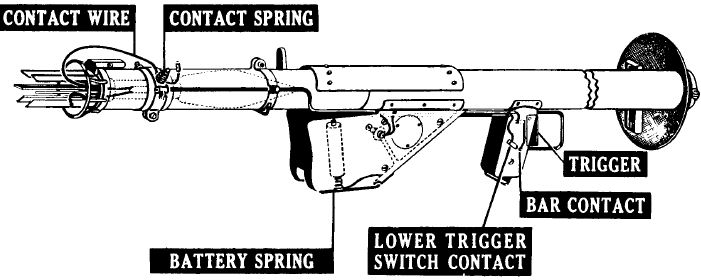
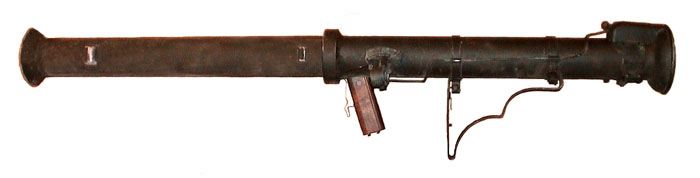
The M1 Bazooka anti tank rocket launcher was built around the steel launching tube (smoothbore barrel), opened at both ends. Rockets were loaded into the barrel from the rear. After loading, rocket had to be connected to the electric firing system by its own wire, which is attached to the contact spring next to the rear end of the barrel. Bazooka rocket launcher was fitted with wooden shoulder stock that has compartments for four D-cell dry batteries – two to power rocket ignition system and two spares. Small signal lamp was fitted to the side of the shoulder stock to test the launching circuit. The pistol grip had simple trigger which closed the ignition circuit when pulled, and weapon initially lacked any manual safeties
After frustrations through much of October, the main Allied attacks kicked off on 13 November. The French First Army used its two armored divisions and its experienced colonial infantry divisions to liberate Belfort and Mulhouse. The French reached the Rhine on 19 November. Meanwhile, the Seventh Army had several divisions that had developed sound mountain-fighting experience in the Italian campaign and managed to push through the Vosges via two mountain passes. Although armor was used in a supporting role in the fighting, this was primarily an infantry contest.
The Seventh Army’s armored reserve at this point was the French 2e DB, which remained under American command through most of 1944 because of political differences between Leclerc and the French First Army leaders. When the Seventh exited the mountain passes to the Rhine plains, the 2e DB was unleashed and made a dash for the provincial capital of Strasbourg, which was liberated on 25 November. Gen. Jacob Devers, the 6th Army Group’s commander, proposed to leap-frog the Rhine and advance up its eastern bank in order to unhinge German defenses standing in Patton’s way, but Eisenhower was skeptical of this approach. Instead, the Seventh Army was given the task of striking toward Hagenau and the Wissenibourg gap in the hopes of undermining German defenses on the western bank of the Rhine, while the French First Army continued to struggle against a large pocket of German troops still holding out on the western side of the Rhine around Colmar.
A French M4A4 of the 2e Cuirassiers, 1 e DB (French 1st Armored Division) knocked out during the fighting on the approaches to Alsace in the autumn of 1944.
A U.S. Seventh Army M7 105mm howitzer motor carriage crosses a hastily repaired bridge near Remiremont on 24 September. Typical of vehicles that had served in Italy, it is a 1942-production vehicle upgraded in the field with a piece of armor welded behind the machine-gun pulpit to extend the side panel upward to cover the hull ammunition racks. It is also refitted with the later suspension bogies.
On 21 September, American troops inspect a 37mm Flakpanzer, popularly dubbed the Mobelwagen (“furniture truck”), abandoned in Vertigny during the German retreat into the Vosges Mountains. This was a specialized antiaircraft version of the Pz.Kpfw. IV tank armed with a 37mm automatic cannon.
September 1944 was one of the wettest on record in Europe, with many fields being turned to mud by the rain. Here, an M4 of the 59th Armored Field Artillery Battalion’s HQ company is retrieved by a wrecker after having become bogged down in a field near Plombieres on 26 September.
In the autumn of 1944, the Germans began deploying surplus tank guns on expedient pedestal mounts to create hasty defensive lines along the German frontier. One of the first of these guns in action was an SK-L Ila pedestal 88mm KwK 43 gun from Festungs-PaK-Verband XXVI (XXVI Fortress Anti-Tank Unit) on a standard Betonfundament concrete pad positioned in the Saverne gap in the High Vosges to block access to Phalsbourg as part of the Vosges Line. This particular gun was originally intended for the Jagdpanther tank destroyer. This position fell during the fighting with the U.S. Seventh Army in November, one of thirty-two of these guns lost in this campaign.
An M4A1 of the 756th Tank Battalion knocked out during the fighting in Vagney, France, on 8 October. This is a tank from the early-production batch of about 250 M4A1 s with the direct vision ports for the driver. Like many veterans of the Italian campaign, the 756th Tank Battalion had a large number of old tanks when it arrived in southern France.
This Panther turret was intended for emplacement as a fixed Panzerturm in the Saales Pass in November on a concrete bunker, but it was overrun before completion. This is an example of a Pantherturm-Stellung based on a surplus tank turret rather than a newproduction Ostwallturm, which was a dedicated fortification Panther turret with thicker roof armor.
The men of an M4 (105mm) assault gun crew of the HQ Company, 191st Tank Battalion, cook food during a lull in the fighting near Rambervillers, France, on 15 October. The M4 (105mm) was fitted with a 105mm howitzer instead of the normal 75mm gun and was used to provide indirect fire support for the battalion. In 1944, most tank battalions had six of these attached to their headquarters company.
An M4A3 (76mm) medium tank of the 756th Tank Battalion, supporting the 3rd Infantry Division near Brouvelieures, France, in October. The crew has started to weld metal strips to the glacis plate as the first step in applying a layer of sand bags to add further protection to the tank. The M4 was not well protected against typical German antitank weapons like the Panzerfaust and Panzerschreck, which led to many improvised armor improvements in the field.
The Polish TKS tankette was used for antipartisan patrols by German forces on the Russian front and in the Balkans and was rarely encountered in the West.
Riflemen of the Japanese-American 442nd Infantry Regiment near Bruyeres pass by a disabled German Leichte SPW U304(f), an armored conversion of the captured French Unic Kegresse P107 half-track.
The M4 (105mm) assault gun was a prodigious consumer of ammunition since it was normally used on firesupport missions like normal field artillery. Here, one of the crewman helps load a 105mm round through the shell ejection port on the left turret side. The stenciled 5698GG marking is a shipping code for the unit.
During the campaign along the Meurthe River, the 21st Panzer Division was committed against the U.S. Seventh Army in October. This is a pair of Panthers of the division knocked out near Autrey to the east of Vesoul in a tank battle with American forces in late October.
Two M31’s of the 753rd Tank Battalion recover an overturned truck near Les Rouges Eaux, France, on 22 October. The M31 nearest the camera is named Sad Sack.
A close-up view of the M31 Sad Sack during the recovery effort by the 753rd Tank Battalion on 22 October.
An M4 medium tank and M8 armored car of the 753rd Tank Battalion pass by the town church of Brouvelierures while supporting the 36th Division during the fighting for the Vosges mountain passes on 29 October.
An M4A1 of the Seventh Army knocked out near La Salle, France, on 3 November. The GI points to where a German antitank shell penetrated the hull armor and then passed through the turret race. This is an early-production M4A1 with the early-pattern bogie assemblies. The Seventh included many units that had fought in 1943 in the Italian theater and so had a large amount of older equipment.
The rainy conditions in the autumn of 1944 are graphically shown in this view of an M4A3 (105mm) assault gun of the 756th Tank Battalion, seen near Les Rouges Eaux on 8 November.
An M12 155mm gun motor carriage of Battery C, 557th Field Artillery Battalion, near Morteau, France, on 15 November. This photo shows the recoil chocks placed under the front tracks and the hoops for the camouflage net erected over the gun compartment. This vehicle is unusual in that it is still fitted with the front portion of the sand skirts, a feature not commonly seen on the M12 155mm gun motor carriage in Europe.
A 75mm PaK 40 auf Chenillette (f) abandoned in Vesoul. This was a Becker conversion done in France to reinforce the poorly equipped garrison forces in 1942-43. This type of conversion was more commonly seen with the 21st Panzer Division in Normandy than in Alsace, but some elements of the division served in the Lorraine campaign in the autumn.
An M4 tank is covered in a fresh coat of wet snow on a roadside near Belmont, France, after having run over a mine on 12 November. The tank has already been roped off by engineers with white cloth tape, the usual precaution in mined areas.
A rare example of a late-production Sd.Kfz. 251/17 half-track armed with 2centimeter KwK 38 is seen knocked out in the ruins of La Bourgance during the fighting with the 3rd Infantry Division on 15 November in the Vosges Mountains.
An M2A1 command post vehicle of the 56th Armored Infantry Battalion, 12th Armored Division, lands in France at Le Havre from an LST on 15 November. This was the second American armored division assigned to the Seventh Army and the last to arrive. The French 2e DB and U.S. 14th Armored Division were already in combat in Alsace by this time.
The le Spahis, the reconnaissance element of the French 2e DB, pass through Brouville on 17 November during the approach to the Alsatian capitol of Strasbourg. The unit was equipped with the M5A1 light tank and M8 light armored car.
On 17 November, the crewmen of an M4A3 (76mm) tank of the 712th Tank Battalion perform a “show and tell” for a Signal Corps photographer to demonstrate how a German Panzerschreck rocket launcher knocked out their tank near Metzervisse. The crewman on the right is showing the small penetration hole caused by the rocket’s shapedcharge warhead.
An M10 3-inch gun motor carriage tank destroyer takes up covered positions in the Vosges foothills during the fighting around St. Benoit in November.
The effect of a Panzerfaust antitank rocket could be catastrophic if it detonated the internal ammunition of an M4. This M4A2 of the French 5e DB, serving with the U.S. 6th Army Group in Alsace, had its turret blown off after a Panzerfaust set off its ammunition during the fighting in Issans on 18 November. The tank’s hull can be seen in the distance.
A German Sd.Kfz. 251/21 with triple machine-gun mount, possibly from Panzer Brigade 106, was knocked out by Seventh Army artillery in St. Michel-surMeurthe during the fighting on 20 November.
An M10 3-inch gun motor carriage with the XV Corps during the fighting on the approaches to Sarrebourg in late November. This is probably one of the M1 O’s of the RBFM, the tank destroyer battalion of the French 2e DB, which was the main armored element of the attack.
Infantry of the French 3rd Moroccan Infantry Division (3e DIM), supported by camouflaged Sherman tanks, pass through Rochesson during the fighting along the Rhine in November.
An M4A2 tank of the French 5e DB crosses a treadway bridge near Belfort on 20 November during the siege of that city. Logs were carried on the tanks in corduroy bundles that were placed under the track in muddy ground conditions to improve traction.
An M4A2 tank of the French 5e DB with infantry support moves into the outskirts Belfort on 20 November during the efforts to penetrate the Belfort Gap onto the Alsatian plains along the Rhine. Although the Free French Army was equipped mainly with American equipment and uniforms, some French armored units managed to locate prewar French crew helmets, as can be seen on several of the troopers behind the tank.
Fontenay, an M4A4 of the 2e Cuirassiers, French le DB, takes part in the attack on the Gestapo headquarters in Mulhouse on 22 November.
A pair of M4A4 medium tanks of the 2e Cuirassiers, 1e DB, during the fighting for Mulhouse on 22 November. One of the key cities in the Belfort gap, Mulhouse covered access to the Rhine plains and so was a key objective of the 6th Army Group’s offensive.
Two French M4A2 tanks of the French 1 e DB fire on German defenders near the Lefevre Kaserne in Mulhouse on 23 November during the attack of the French First Army beyond Belfort. Obscured by the smoke is an M7 105mm howitzer motor carriage in the background in front of the two tanks.
On 23 November, the Panzer Lehr Division began a counterattack from Sarre-Union against the Seventh Army, hitting two regiments of the 44th Division. This Panther Ausf. G was knocked out near Schalbach on 25 November during fighting with the 114th Infantry. There is a bazooka hit evident on the hull side immediately below the turret. The Panzer Lehr was forced to abandon the attack when the 4th Armored Division launched a flank attack from Fenetrange with its Combat Command B.
M4A1 medium tanks refuel and rearm in the town square of Sarrebourg on 24 November. The nearest tank carries the name Audrey.
GIs look over a well-camouflaged 88mm PaK 43 antitank gun positioned in front of Hotel Mazeran in the Saales Pass on 25 November during the fighting in the Vosges Mountains.
The 14th Armored Division was one of the last American armored divisions to arrive in France, docking at Marseilles on 31 October. It was committed to the fighting in the Vosges region on 20 November, and here, some M4A3 tanks of its Combat Command A move forward near Cirey on 23 November.
After the Seventh Army burst out of the Vosges in mid-November, Gen. Alexander Patch unleashed his mobile exploitation force, the French 2e Division Blindee.The advance of Leclerc’s 2e DB was so sudden and unexpected that when the French tanks burst into Strasbourg on 23 November, the citizens were going about their business with no expectation of the drama that was unfolding. This photo was taken a few days after the liberation, with the damaged Notre Dame cathedral in the background.
An M10 3-inch gun motor carriage of the RBFM, knocked out in Strasbourg on 25 November.
An M10 of the RBFM, French 2e DB, on the approaches to Strasbourg during the mid-November fighting.
The rainy conditions in the autumn of 1944 undermined roads and led to accidents like this one where a M4A3 (76mm) of Company A, 781st Tank Battalion, slid off the road in Lamberg after the bank collapsed under its weight. It is being recovered by one of the new M32 armored-recovery vehicles.
The M4 (named Brive-la-Gaillarde) of Lieutenant Krebs, leader of the 3rd Platoon, 3rd Squadron, 12th Cuirassiers, French 2e Division Blindee, advances through Strasbourg on 25 November. It carries the distinctive Cross of Lorraine insignia unique to this division, which always fought in American armies, in this case with Patch’s Seventh Army. The other French armored divisions of the French First Army carried the 1804 Napoleonic flag instead.
A GI inspects a StuG III in Molsheim during the fighting in the Alsace region of France. Two of its side skirts have been removed and placed in front to provide improvised camouflage.
A GI looks over an M4 tank of the 756th Tank Battalion knocked out by a German StuG III during an engagement near Mutzig on 26 November while supporting Task Force Whirlwind from the 3rd Division.
M4A3’s of the 14th Armored Division pass by three other Shermans knocked out by German mines near Barr, France, on 29 November. These are very lateproduction M4A3 tanks, evident from the late-style 75mm gun turret with its improved commander’s vision cupola and the raised rear bustle casting.
GIs from Company B, 114th Infantry, 44th Division, hop aboard M5A1 light tanks of the 749th Tank Battalion in Struth, France, on 28 November following the fall of Sarrebourg. By this stage, the sand bags added to the glacis plate have become a heap of mud from the wet weather.
An M3A1 half-track (named Baby Bastard No. 1) passes the burning wreck of an M4A3 (76mm) medium tank of the 48th Tank Battalion, 14th Armored Division, knocked out during the fighting in Barre on 29 November.
A column of M4A3 tanks from Combat Command A, 14th Armored Division, halts in the Alsatian village of Scherwiller on 2 December during the Seventh Army’s assault toward Selestat. These are late-production vehicles with the oval loader’s hatch and the commander’s all-round vision cupola.
The crew of an M18 76mm gun motor carriage of the 602nd Tank Destroyer Battalion loads ammunition in SaarUnion on 2 December. The ammunition came packed in black fiber-board containers, and the crew can be seen removing them from the tubes to load in the ammunition racks inside the M18.
Panzer support for the German Nineteenth Army in the Belfort Gap was scant. The badly depleted Panzer Brigade 106 served as its fire brigade, rushing from spot to spot in hopes of averting catastrophe. One of its Pz.Kpfw. IV tanks is seen on fire after being hit by bazooka fire during a skirmish with the French 4e DMM in the Hardt Woods near Pont-du-Bouc, north of Mulhouse, during the fighting for the Belfort gap in the first days of December.
Riflemen of the 313rd Infantry, 79th Division, advance into Bischwiller on 8 December while supported by M5A1 light tanks of Company D, 191st Tank Battalion.
Source and Excerpt: Armored Attack 1944: U.S. Army Tank Combat in the European Theater
THE ACME OF guerrilla skill is to spring an ambush on a completely unsuspecting foe—something that the Indians of North America managed to accomplish on too many occasions to count. The most famous such ambush occurred on July 9, 1755, when a combined force of French soldiers and Indian warriors caught a column of British and colonial soldiers in the woods near Fort Duquesne, the site of present-day Pittsburgh. Some 600 men, out of 1,469, were killed, including the British commander, General Edward Braddock. His aide de camp, a young officer named George Washington, barely escaped this debacle. The massacre at the Monongahela was particularly notable because the Indians’ enemies were armed soldiers who should have been ready for battle—but weren’t.If even large bodies of troops could be caught unawares, it should not be terribly surprising that farming communities on the frontier were regularly caught by surprise. One of the first and most devastating such attacks occurred near Jamestown, the first permanent English settlement in North America, located near modern-day Williamsburg.
The English colonists suspected nothing amiss on Friday morning, March 22, 1622. Powhatan Indians were showing up in great numbers on the outlying plantations scattered for eighty miles around Jamestown. Those plantations had sprung up in recent years to farm a lucrative new crop—tobacco. There was nothing unusual about such visits. The Indians would bring deer, turkey, fish, fruit, and fur and in return would get beads and other trinkets that they valued. It was a clash of cultures, with the English in their cumbersome woolen clothes and leather shoes while the Indian men wore nothing but loincloths and moccasins, their faces brightly painted, heads half shaved, and elaborate earrings dangling from their ears. But by then each side was familiar with the other. The Indians were unarmed, so they aroused no suspicion.
Relations between settlers and Indians had been tense initially when the first ships of the Virginia Company had arrived fifteen years earlier carrying a hundred or so settlers to establish what would become the first permanent English colony in North America. Clashes were frequent, and in the early days the English would never have permitted the Indians to roam around their colony as they did in 1622. But peace had generally prevailed since 1614. The preceding year the English had kidnapped Pocahontas, the daughter of Powhatan, founder of an empire of ten thousand Indians stretching around Jamestown like a vast human necklace. Pocahontas converted to Christianity and married a settler, and her father reached an accommodation with his new in-laws.
In 1618 Powhatan died but his successor and half brother, Opechancanough, promised to continue friendly relations. He told the colonists that “he held the peace concluded so firm as the skies should sooner fall than it dissolve.” Many of the English believed that they were in “a happy league of peace and amity” with the natives and “that the fear of killing each other is vanished away.” Only too late would they realize this was “treacherous dissimulation” on the part of a clever chieftain who nurtured deep-seated hatred of the newcomers, who were encroaching on his lands and trying to convert his people to an alien religion. Opechancanough had concocted an elaborate plot to destroy the invaders before any more ships could arrive to swell their ranks even further.
On the morning of March 22, 1622, all of the Indians appeared to be friendly. Some even sat down to breakfast with their hosts. The colonists were going about their normal routines—planting corn and tobacco, gardening, building, sawing. Without warning, wrote John Smith, one of the founders of the colony, the “cruel beasts . . . slew most barbarously, not sparing either age or sex, man, woman, or child, so sudden in their execution, that few or none discerned the weapon or blow that brought them to destruction . . . most by their own weapons.” Those weapons ranged from swords to axes, knives, hammers, and saws. Picking up these crude implements, the Indians went on a marauding rampage, killing every European they could find, including women and children. “And not being content with taking away life alone,” an official report noted, “they fell after upon the dead, making as well as they could a fresh murder, defacing, dragging, and mangling the dead carcasses.”
Jamestown itself was on guard because it had been warned in advance by a Christian Indian, but the attackers moved so quickly from farm to farm that there was no time to organize a general defense against what one Englishman described as this “viperous brood” and another called “those hell-hounds.” The attack wiped out more than one-fourth of the colonists—347 out of 1,240—and put the entire colony on the brink of extinction.
Yet Captain Smith, who had long counseled a hard line against the natives, perceived a chilling bit of good news in this disaster: “Some say [this massacre] will be good for the plantation because now we have just cause to destroy them by all means necessary.” Sir Francis Wyatt, governor of Jamestown, agreed on the need to “pursue their extirpation.” But he realized that a straightforward assault would be unlikely to succeed. “It is most apparent,” he wrote, “that they are an enemy not to be suddenly destroyed with the sword by reason of their swiftness of foot, and advantages of the wood, to which upon all our assaults they retire.”
Instead he proposed to wipe them out “by the way of starvings and all other means.” Punitive expeditions were sent to burn the Powhatans’ towns and steal or destroy their corn, thus bringing them to the brink of starvation the following winter. Two months after the initial attack, on May 22, 1623, a party of Englishmen lured the war-weary Indians for peace talks and served them poisoned wine. The peace negotiators then fired a “volley of shot” into the incapacitated Powhatan, killing two hundred of them. On their way back to the colony, the Englishmen shot fifty more Indians “and brought home part of their heads.”
The pattern was set for almost three centuries of what the Virginia Company directors would describe after the Jamestown uprising as “perpetual war without peace or truce.” Perpetual it was, but it was not war as understood on the battlefields of Europe. It was a frontier style of fighting that was marked by treachery and surprise and massacre on both sides. In other words, it was guerrilla warfare, a phrase not usually associated with seventeenth- and eighteenth-century colonial history.
THE JAMESTOWN SETTLERS were among the first to discover what many Europeans would learn: that Indians excelled at the “skulking style of war.” The Indians of eastern North America were not nomads like the tribes of Inner Asia or the tribes that would come to populate the Great Plains. They lived in permanent villages for most of the year, in birch-bark wigwams sometimes ringed by wooden palisades, and grew corn, squash, and other crops. But farming was considered women’s work. The men were left free to hunt, fish—and make war. Like many other prestate peoples, their hunting skills made them effective killers whether stalking animals on four legs or two. “However absurd it may appear,” wrote George Washington, who as a young man fought with and against Indians on the Virginia frontier, “it is nevertheless certain” that “five hundred Indians” could be a more potent fighting force “than ten times their number of Regulars.”
That was only true, however, when the Indians fought in a stealthy manner. In 1492, when the first Europeans landed in the New World, the indigenous peoples did not have horses, wheels, steel, or firearms. They fought on foot with wooden swords, spears, slings, clubs, axes, and bows and arrows tipped with obsidian, flint, or bone. Thus equipped, they could not stand in the open against the Europeans and their “thunder sticks.”
The explorer Samuel de Champlain and two other French soldiers had enough firepower between them to rout two hundred Mohawk Indians. Just after daybreak on July 30, 1609, on the shores of what is now Lake Champlain in New York State, Champlain calmly walked in front of a group of his Algonquin and Huron allies who were at war with the Mohawk. They were standing in a tight array, wearing wooden armor and holding shields. Champlain raised his arquebus, a primitive musket that had been loaded with four balls, and fired a single, deafening shot that knocked over three Mohawk at once, two of them chiefs easily recognizable by the feathers they wore on their heads. “As I was loading again,” he recalled, “one of my companions fired a shot from the woods, which astonished them anew to such a degree that . . . they lost courage, and took to flight . . . fleeing into the woods, whither I pursued them, killing still more of them.”
Not all Indian societies survived such disastrous initial contacts.10 Some, such as the Caribs and Arawaks of the West Indies, were wiped out altogether by a combination of European weapons and European microbes in what the historian Edmund S. Morgan rightly calls a “tale of horror.” (Morgan explains “the fury with which the Spanish assaulted the Arawaks even after they had enslaved them” by arguing that the Indians’ innocence and austerity—they required and wanted little in the way of worldly goods—was an affront to “the Europeans’ cherished assumption of their own civilized, Christian superiority over naked, heathen barbarians.”) Ironically, the most advanced societies—the Aztecs and Incas—suffered the most devastating defeats because, like the Zulus or the South Asians, they were so tightly organized and so hierarchical that they could mass thousands of warriors in the kind of open battle at which Europeans excelled. Moreover, these states were so densely populated that they could transmit smallpox and other plagues “like ink spreading through tissue paper.”And they were so centralized that the loss of a few key leaders could immobilize the rest of society. Less centralized, less populous, less sophisticated societies fared better because they had no choice but to place heavy reliance on guile and subterfuge to resist the better-armed newcomers—they employed guerrilla tactics such as the raid on Jamestown orchestrated by Opechancanough.
Indian ambushes became even more formidable once their warriors learned to make use of the guns, horses, and steel introduced by the Europeans, a process that was just beginning in Opechancanough’s day. Although colonial authorities tried to keep Indians from getting their hands on firearms, they acquired all they needed through trade or theft. While they never fully gave up the bow and arrow, their marksmanship soon exceeded that of most settlers, who were mainly farmers and craftsmen, not hunters or soldiers.The dense woods of eastern North America greatly abetted the Indians because they made the Europeans’ parade-ground formations and volley fire difficult to execute, providing a contrast between the inflexibility of the newcomers, prisoners to imported and inappropriate tactical doctrines, and the shrewdness and adaptability of the natives who developed a way of war ideally suited to their environment. Gliding between the trees, the Indians were able to carry out raids and ambushes that took advantage of what was, to the colonists, unfamiliar terrain. Having no need of cumbersome supply trains, they could survive for extended periods on acorns, nuts, ground-up animal bones, even tree bark, thereby allowing them to move much faster than colonial militias.
Like their settled forebears dating back to ancient Mesopotamia, New England farmers had trouble defending themselves against highly skilled tribal guerrillas. “Scarcely a hamlet of the Massachusetts and New Hampshire borders escaped a visit from the nimble enemy,” the nineteenth-century historian Francis Parkman wrote of the French and Indian wars that raged from 1689 to 1759. “[All] were all more or less infested, usually by small scalping parties, hiding in the outskirts, waylaying stragglers, or shooting men at work in the fields, and disappearing as soon as their blow was struck.”
FOR ALL THEIR skill at the art of ambush, the Indians got the worst of the “forest wars” waged along the Eastern Seaboard in the seventeenth and eighteenth centuries. The outcome may seem inevitable in retrospect, but that was not how it appeared at the time. In Jamestown in 1622 the colonists, not the Indians, seemed to be on the brink of extinction. Why did the Indians lose in the end? Principally because of two critical deficiencies—a lack of population and a lack of unity.
Detail from “Deffaite des Yroquois au Lac de Champlain,” Champlain Voyages (1613). This self-portrait is the only surviving contemporary likeness of the explorer.A 1628 woodcut by Matthaeus Merian published along with Theodore de Bry’s earlier engravings in 1628 book on the New World. The engraving shows the March 22, 1622 massacre when Powhatan Indians attacked Jamestown and outlying Virginia settlements. Merian relied on de Bry’s earlier depictions of the Indians, but the image is largely considered conjecture.Powhatan, detail of map published by John Smith (1612)
The Treaty of Neuilly, strictly theTreaty of Neuilly-sur-Seine, was signed with Bulgaria after World War One had ended. The treaty was signed on November 27th 1919. … Post-Neuilly, the Bulgarian Army was limited to just 20,000 men. Bulgaria was ordered to pay reparations of £100 million.
Land in western Bulgaria was given to the future Yugoslavia – at the time of Neuilly what was to become Yugoslavia was called the Kingdom of Serbs, Croats and Slovenes. Bulgaria also had to recognise the legal existence of the new state and cession of land was seen as recognition that Bulgaria had forcibly occupied parts of Serbia between 1915 and 1918 and this was part of Bulgaria’s punishment.
When the Bulgarian people learned of the terms of the Treaty of Neuilly, they were outraged. However, they were not in a position to do anything about the terms in 1919. When World War Two broke out, Bulgaria sided with Nazi Germany and reclaimed all the land taken from her by the Treaty of Neuilly. By the time World War Two ended, Bulgaria’s effective independence was also ended. Stalin imposed a pro-communist government in power – part of his protective block around the USSR and it was to be many more decades before Bulgaria was to enjoy any form of real independence.
Bulgaria as the ultimate disaster for the Bulgarian nation’s strife for national liberation and unification.
With the Neuilly Treaty Bulgaria’s claims to wide swaths of territories in Macedonia, Thrace, and Dobrudja, largely populated by Bulgarians, suffered a terrible defeat
area of 2563 km² on the western border to the Kingdom of Serbs, Croats and Slovenes. The treaty also forced Bulgaria to return Southern Dobruja, which had been captured during the war and restored the border set by the Treaty of Bucharest (1913). (Southern Dobrudzha was restored to Bulgaria in 1940.)
In Bulgaria, the results of the treaty are popularly known as the Second National Catastrophe.
In Serbia, to which the term generally applies in Bulgaria, the territory ceded is split between the modern Serbian District of Pirot(municipality of Dimitrovgrad and smaller parts of the municipalities of Pirot and Babušnica) and District of Pčinja (municipality of Bosilegrad and a small part of the municipality of Surdulica). It also includes a small section along the Timok River in the municipality and District of Zaječar, composed by eight localities (seven populated by Vlachs and one populated by Bulgarians).
In 1919, the area corresponded to the following parts of the Bulgarian okrugs: Kyustendil, 661 km2 (255 sq mi), Tzaribrod418 km2 (161 sq mi), Tran 278 km2(107 sq mi), Kula 172 km2 (66 sq mi) and Vidin 17 km2 (6.6 sq mi). Bulgarian sources claim that the Bulgarian population made 98% of the population in Bosilegrad and 95% of the population in Tzaribrod at the time. In the Yugoslav census of 1931, all South Slavs were simply counted as Yugoslavs (Serbs, Croats, Slovenes, Bulgarians) so a comparison could not be made. According to the last Census in Serbia from 2002, Bulgarians made 50% and 71% of population in Dimitrovgrad and Bosilegrad respectively.